METODO.MD · How my most recent projects were built

PROJECT 11 / 11 · AI · Method

Building with AI agents

My current system to build real projects with AI agents, used in the most recent projects on this page: reusable skills, a decision log per project, separate agent roles that build and review, and cost control for each batch of agents.

  • In daily use
  • Claude Code
  • 2026
In daily use CLAUDE CODE · SKILLS · AGENTES · REGISTRO
01 / IMAGES.DIR

Project overview.

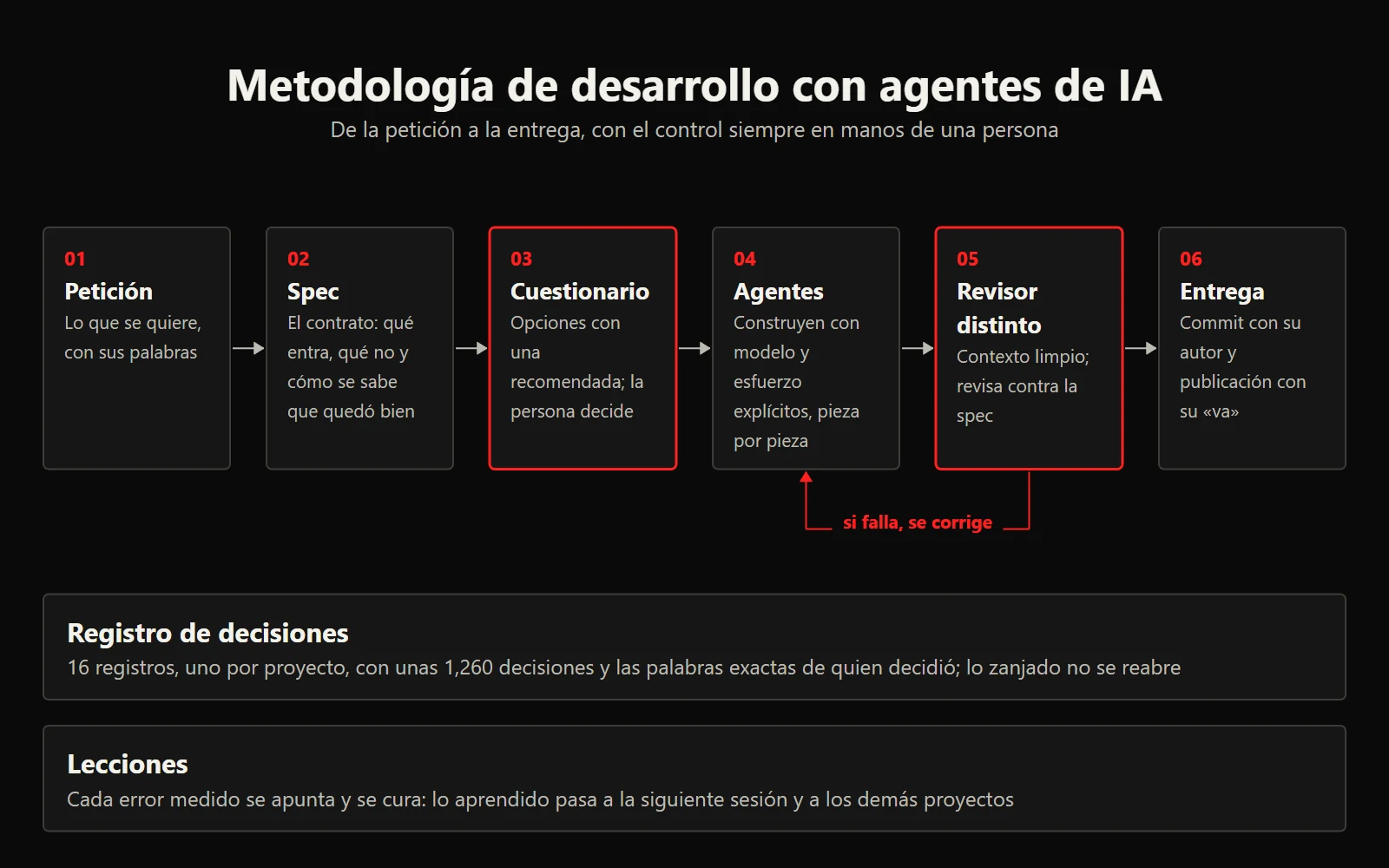
The diagram sums up the method. It is an explanatory drawing (in Spanish) made with my own diagram skill, not a screenshot.

IMAGES.DIR
From the request to the delivery: spec, questionnaire, agents, an independent reviewer, and the decision log and lessons underneath (opens in a new tab)
From the request to the delivery: spec, questionnaire, agents, an independent reviewer, and the decision log and lessons underneath
Diagram of the method

02 / STACK.INI

Tech stack.

What each piece does in this project. Hover over a tool, tap it or tab into the list to light it up.

  • Claude CodeMain session, agents and workflows
  • SkillsReusable instructions: decisions, agent deployment, diagrams, video…
  • WorkflowsAgent roles: builder, reviewer, researcher, reader, extractor and final verdict
  • HooksInject the language, the decision log and the date-check rule each turn
  • ObsidianThe vault where the decision logs and lessons live
  • PythonThe tool that numbers, writes and checks every decision
  • Git · GitHubOne piece at a time, one commit per piece

03 / README.TXT

About the project.

README.TXT

Problem

Working with AI on real projects tends to repeat mistakes, reopen decisions and overspend: each session starts from scratch and nobody reviews what the model did.

Solution

A written method: a spec before building, multiple-choice questions before each change, agents with explicit model and effort, an independent reviewer with a clean context, and everything decided or learned saved where the next session reads it.

Key features

  1. Decision logEvery decision with the exact words of whoever made it, its date and a second opinion; it is loaded at the start of each session so it isn’t reopened.
  2. Questions with optionsBefore any change, a questionnaire with a recommended option and what each one implies; the person decides.
  3. Separate rolesWhoever builds doesn’t review its own work: a different agent with a clean context checks it against the spec.
  4. Cost under controlEach batch of agents is planned with model, effort and estimated usage, starting with a pilot before the full wave.
  5. Checked at the sourceVersions, prices and project status are checked against the primary source, with its date, before being stated.

It grows with use: every mistake that gets measured becomes a lesson, a rule or a check, so it doesn’t happen again in the next project.

Ready UTF-8 · LF · 28 L

04 / ARCHITECTURE.SYS

How it works.

Who does what, and where what was decided and learned is kept.

ARCHITECTURE.SYS

PERSON

  • RequestWhat is wanted
  • DecidesAnswers the questionnaire

CLAUDE CODE

  • Main sessionSpec, questions and one piece at a time
  • AgentsBuild and review separately

MEMORY

  • Decision logOne per project
  • Lessons and skillsWhat the next session reads
Architecture diagram — The person decides, Claude Code builds and reviews, and the memory keeps it all for next time.

Data flow, step by step

  1. The request becomes a spec: what goes in, what stays out and how we’ll know it’s right.
  2. Before each change, a questionnaire with options; the answer goes to the decision log.
  3. The work is done one piece at a time; large batches go to agents with explicit model and effort.
  4. An independent reviewer checks the result against the spec before it is delivered.
  5. What was learned is written down so the next session starts where this one ended.

Engineering notes

  • The person decidesAI proposes with options and a recommendation; nothing gets done without asking first.
  • A clean context to reviewThe reviewer doesn’t share the builder’s context, so it doesn’t inherit its blind spots.
  • Measured, not guessedQuality is measured on the result (the render, the build, the screenshot), not on the design values.

05 / PROPERTIES.CPL

Project properties.

PROPERTIES.CPL · AI agent development methodology

Platform
Claude Code on Windows, with an Obsidian vault
Type
My own working method
Status
In daily use
Year
2026Used in my most recent projects
My role
Design of the method and its tools
Built for
My own
Repository
PrivateLives in my configuration and vault

06 / LINKS.LNK